
|
| Torâh | Haphtârâh | Âmar Ribi Yᵊhoshua | Mᵊnorat ha-Maor |
|---|---|---|---|

Contributing to Centuries of Associations with the Devil
© 2012 Yirmeyahu Ben-David. No duplication of any kind without proper attribution, including link to this website.
 |
 Har Sin•aiꞋ (Har Kar• Har Sin•aiꞋ (Har Kar• |
Israeli recognition that the Creator is a Singularity dates back to Av•râ•hâmꞋ. Mosh•ëhꞋ surely understood that ha-Qâ•doshꞋ, bâ•rukhꞋ hu, the Singularity, could not be fully represented in the physical world. It follows, that he understood that seeing "His kâ•vodꞋ" meant witnessing some physical manifestation by His Hand.
The most potent physical manifestation of Divine Power as perceived in the ancient world was the lightning bolt.
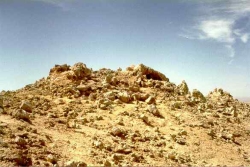
At the top of Har Sin•aiꞋ (viz., Har Kar•komꞋ) protrudes a natural צוּר bim•âhꞋ of (on right side of summit in photo). "Behold the place with Me – you station yourself on that צוּר" (Shᵊm•otꞋ 33.21).
In the side of the natural צוּר bim•âhꞋ, at the top of Har Sin•aiꞋ, notice that there is a ni•qᵊrâhꞋ. "When the passing-through of My kâ•vodꞋ shall have become, then I will put you in the ni•qᵊrâhꞋ of the צוּר" (Shᵊm•otꞋ 33.22).
33.20 "Then He said, 'You're not able to see My Face because hâ-â•dâmꞋ shall not see Me and live… 22 So I shall cover you over with the Palm of My Hand until I've passed by 23 Then I will remove My Palm and you will have seen My Rear…"
How can this passage be understood in terms of manifestations of thunderbolts? Mosh•ëhꞋ had spent days on the mountain trying to unify thirteen different sets of tribal law into one unified set of laws that would unify Yi•sᵊ•râ•eilꞋ as one nation. He needed affirmation – a sign – that his work had the imprimatur of ha-Qâ•doshꞋ, bâ•rukhꞋ hu.
One of the reasons that certain mountains were considered holy from antiquity doubtless traces to the proclivity of lightning to strike its summit during the rainy winter months. Most deaths from lightning results from cardiac arrest. In antiquity, no one knew CPR. Being hit by lightning was considered to having seen the face of a god and been struck – generally fatally. To explain those who survived likely entailed rationalizing that they must have been affected only by what we would call a secondary or nearby flash (bolt), which they may have regarded as the "rear" of the god.
In such case, Mosh•ëhꞋ would have interpreted these instructions as meaning that, at the first sign of His Coming (manifestation – lightning nearby), he should take cover in the ni•qᵊrâhꞋ immediately below where he had stationed himself, in order to avoid seeing His Face. He would have interpreted a lightning strike on the צוּר, which would have been blindingly brilliant, as the blinding Palm of ha-Qâ•doshꞋ, bâ•rukhꞋ hu, covering him from seeing the Face of ha-Qâ•doshꞋ, bâ•rukhꞋ hu. Perceiving that ha-Qâ•doshꞋ, bâ•rukhꞋ hu had "passed by," Mosh•ëhꞋ would then have ventured out of the ni•qᵊrâhꞋ to see "אֲחֹרָי." At this point, it appears that Mosh•ëhꞋ either saw, or was struck by, a secondary lightning strike. In either case, the evidence strongly suggests that, whether by the first bolt or the second, Mosh•ëhꞋ was certainly struck by lightning.
"The red-hot air in a jagged bolt of lightning is heated to up to 30,000 degrees Celsius (54,032 degrees Fahrenheit) for a split-second. Sweat and rain water on the skin explode instantly at this temperature. Sometimes this explosion of moisture rips the victim's clothing and shoes from his body. Burns, if any, are usually the result of scalding from the suddenly heated steam." (Lightning Strike Survivors Meet For World Conference, Manfred Dworschak , www.spiegel.de/international/zeitgeist/0,1518,491477-2,00.html; accessed 2012.02.03).
A typical lightning strike carries an impulse current of about 300 kV. "Most of the current from a lightning strike passes over the surface of the body in a process called 'external flashover.' " (Human Voltage, What happens when people and lightning converge; Science at NASA; science.nasa.gov/science-news/science-at-nasa/1999/essd18jun99_1/; accessed 2012.02.03).
A few verses later (Shᵊm•otꞋ 34.29), we discover, "So it was, when Mosh•ëhꞋ descended from Har Sin•aiꞋ, with the two tablets of the Eid•âhꞋ in hand while descending from the Har, so Mosh•ëhꞋ didn't know that:
קָרַן עוֹר פָּנָיו
 |
 Michelangelo's (European, un-Semitic gentile) "Moses" Michelangelo's (European, un-Semitic gentile) "Moses" |
So, why did Michelangelo sculpt Mosh•ëhꞋ with horns? The European translations of the Bible translated this phenomenon as "beams," which they presumed to be a halo-like crown of light rays radiating from the head, as depicted in the many-pointed crowns of kings and ancient sculptures of Zeus – notice also the Statue of Liberty. The longstanding politically correct explanation has been that artists and scultors didn't know any other way to depict rays of light radiating from the head. However, this does not explain why Michelangelo depicted Mosh•ëhꞋ having exactly two horns, protruding from the front top of the head, rather than the "standard" seven rays emanating around the crown of the head.
The oldest translations of the Christian Bible misojudaically mistranslated this phrase into their Bibles as "his face had horns" based on "the Babylonian and Egyptian conception of horned deities (Sin, Ammon), and by the legend of the two-horned Alexander the Great (see the Koran, sura xviii. 85)." (Jewish Encyclopedia.com; accessed 2012.02.05). This resulted in the misojudaic canard that Jews have horns on their heads.
|
|
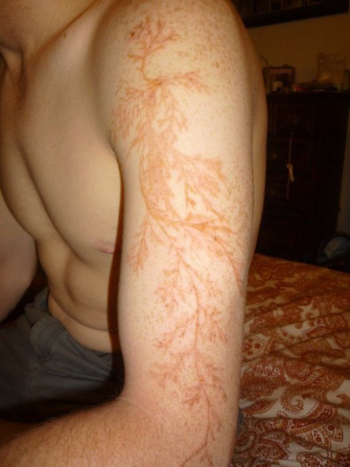 |
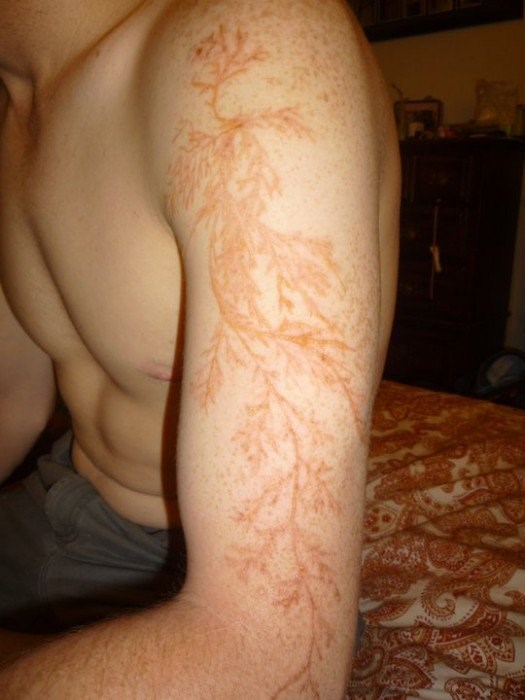 Lightning-strike (keraunographic); fern-leaf feathering tree, “Lichtenberg figures”; burn marks on skin where lightning followed the path of skin blood vessels of Winston Kemp, a 24-year-old electrician. Lightning-strike (keraunographic); fern-leaf feathering tree, “Lichtenberg figures”; burn marks on skin where lightning followed the path of skin blood vessels of Winston Kemp, a 24-year-old electrician. (Cari Nierenberg, NBC News) (Cari Nierenberg, NBC News) |
What is one of the visible aftereffects that a lightning flashover can cause? "An almost pathognomonic cutaneous feature known as feathering [i.e., radiating] or lightning prints comprises linear, fernlike [i.e., radiating], superficial skin markings (also called keraunographic marks [derived from qâ•rânꞋ?]) that disappear after several days. These cutaneous manifestations of lightning injury usually consist of erythematous [radiating] streaks that do not blanch on diascopy. Erythema begins to fade in 4-6 hours with no residual skin changes. This bizarre cutaneous manifestation is probably related to the flashover phenomenon, from the transmission of static electricity along the superficial vasculature."
 |
 |
31.13 – לָדַעַת
כִּי
אֲנִי
Christians have been taught since 135 C.E. that Tor•âhꞋ is the "law of sin and death" because, the Church teaches inter alia, Tor•âhꞋ conditions יְשׁוּעָה upon being perfect in one's works. Setting aside for a moment that יְשׁוּעָה is different from (and never used as) a name, in Tor•âhꞋ this is a military and nationalist term that is never spiritualized to the individual "soul," which the quoted pâ•suqꞋ demonstrates that Tor•âhꞋ teaches exactly the opposite of what Christians historically have ignorantly charged.
 |
שַׁבָּת |
In fact, so central is the teaching אֲנִי
Yi•sᵊ
On this day commemorating the קֹדֶשׁ of ha-Qâ•
Yes, שַׁבָּת commemorates that
כִּפּוּר, like שַׁבָּת, is all worked by
כִּפּוּר, being exclusively through
Be careful of the English, even in a Ta•na"khꞋ published by Orthodox Yᵊhud•imꞋ. We're not perfect either. In the case of 31.15, the phrase in the heading is a mistranslation of שַׁבָּת שַׁבָּתוֹן.
שַׁבָּת indeed derives from the verb meaning to cease or go on strike. The phrase can be translated literally as a "cessation of ceasing" or "cease and desist." However, other passages containing the phrase help us to better understand the meaning of the phrase and the term.
This phrase is found at:
Shᵊm•otꞋ 31.15 (the first instance is this week's passage)—tells us that the seventh day is a שַׁבָּת שַׁבָּתוֹן, (which is) a קֹדֶשׁ for
Shᵊm•otꞋ 35.2—also tells us that the seventh day is a קֹדֶשׁ, a שַׁבָּת שַׁבָּתוֹן for
wa-Yi•qᵊr•âꞋ 16.31—tells us that Yom Ki•purꞋ is a שַׁבָּת שַׁבָּתוֹן, thus equating the קֹדֶשׁ of the two.
wa-Yi•qᵊr•âꞋ 23.3—tells us that the seventh day is a שַׁבָּת שַׁבָּתוֹן of a מִקְרָא-קֹדֶשׁ. This tells us, additionally, that the definition of a שַׁבָּת שַׁבָּתוֹן includes a מִקְרָא-קֹדֶשׁ.
wa-Yi•qᵊr•âꞋ 23.32—reiterates that Yom Ki•purꞋ is a שַׁבָּת שַׁבָּתוֹן and that וְעִנִּיתֶם אֶת-נַפְשֹׁתֵיכֶם .
This specific form is found only four times in Ta•na"khꞋ (Shᵊm•otꞋ 16.31; 23.27, 32 & bᵊ-Mi•dᵊbarꞋ 29.7) and is always found only in this phrase.
wa-Yi•qᵊr•âꞋ 25.4—commands us to make a שַׁבָּת שַׁבָּתוֹן לָאָרֶץ (i.e., for Yi•sᵊr•â•eilꞋ) in the Shᵊmit•âhꞋ year—a שַׁבָּת for
Additionally, the term, שַׁבָּתוֹן by itself, apart from this phrase, is found at:
Shᵊm•otꞋ 16.23—tells us that the first day of Khag ha-Matz•otꞋ, the day beginning with the PësꞋakh SeiꞋdër, is also a שַׁבָּתוֹן, which is a שַׁבָּת קֹדֶשׁ for
 300x198.jpg "Shophar (ayal-ram)") |
 500x330.jpg "Click to enlarge") שׁוֹפָר |
wa-Yi•qᵊr•âꞋ 23.24—Biblical Yom Tᵊru•âhꞋ, misnamed "Rosh ha-Shanah" (New Year) in the modern era, is defined here to be a
Again, and from a different perspective, the emphasis is upon calling (the blasting of the sho•phârꞋ is an emergency alert call) the practicer of Tor•âhꞋ to retrospection, dedication and commitment.
wa-Yi•qᵊr•âꞋ 23.39 (twice)—defines the first and eighth day of Khag ha-Suk•otꞋ, each, as a שַׁבָּתוֹן.
wa-Yi•qᵊr•âꞋ 25.5—reiterates that the Shᵊmit•âhꞋ year is a שַׁבָּתוֹן לָאָרֶץ.
Taking all of these descriptions together, שַׁבָּתוֹן, including the seventh day of the week, is a שַׁבָּת of קֹדֶשׁ for
The most obvious answer is: "That depends on one's definition of "spiritual considerations."
A note to 31.12-17 in the Artscroll Ta•na"khꞋ—(rightly) noting the succession from building the Beit-ha-Mi•qᵊdâshꞋ to giving the mi•tzᵊw•âhꞋ to keep שַׁבָּת—states that: The Tor•âhꞋ teaches that the construction of the Beit-ha-Mi•qᵊdâshꞋ does not override שַׁבָּת. This contradicts those who claim that שַׁבָּת law must be pliable enough to permit its relation for what they regard as valid 'spiritual' considerations. Those who make such claims first transgress, of course, the mi•tzᵊw•âhꞋ against following one's own heart and own eyes (bᵊ-Mi•dᵊbarꞋ 15.39) instead of mi•shᵊpâtꞋ—the Beit-Din.
 |
 Ben-Yehudah St., Yerushalayim - afternoon approaching Shabbat Ben-Yehudah St., Yerushalayim - afternoon approaching Shabbat |
The notion that the ancients' definition of work, mᵊlâkh•âhꞋ, in B.C.E. 1467 is the same as today's definition in the modern world, where work has changed so greatly, is logically invalid. For example, most Orthodox college students regularly study for school exams on שַׁבָּת (not נְצָרִים, of course). Avoiding writing doesn't exclude an activity from being mᵊlâkh•âhꞋ! It permits Orthodox business people to talk deals on שַׁבָּת (and some do). That's mᵊlâkh•âhꞋ too. Orthodox computer programmers may spend hours on שַׁבָּת working out programming problems in their minds. This is hypocrisy. Modern rabbis should clean up their own act before condemning others.
Further, the rabbis unanimously recognize that the principle of pi•quꞋakh nëphꞋësh must (not "may") take precedence over the laws of שַׁבָּת. Where there is a time urgency, something that cannot be done during weekdays, it is essential that the spiritual welfare of another take precedence over the laws of שַׁבָּת. However, this cannot be used merely as an excuse to do mᵊlâkh•âhꞋ that isn't directly aimed at the goal of rescuing a timely-urgent, endangered nëphꞋësh. My point here is that the spiritual nephesh is infinitely (literally) more important than the physical nephesh. There are, and have been, Orthodox rabbis who subscribe to this view. (Rabbi Carlebach was one.)
|
|
 |
32.1 – וַיַּרְא הָעָם, כִּי-בֹשֵׁשׁ מֹשֶׁה לָרֶדֶת מִן-הָהָר
(…and the kindred had seen, that Mosh•ëhꞋ was abashed to descend from the mountain)
The only other instance of בֹשֵׁשׁ in Ta•na"khꞋ is found at Sho•phᵊt•imꞋ 5.28, where this same theme is corroborated.
Mosh•ëhꞋ doesn't come down from the mountain, the popular voices declared. Therefore, "everybody knows" it's because it will be discovered that he has no connection to Ël•oh•imꞋ and so he is ashamed to show his face. So we need to follow our own heart and our own eyes and develop our own understanding of Ël•oh•imꞋ, according to our own understanding. If that sounds repetitive, it is—petitio principii.
This is the kind of reasoning which still passes for "logic" today. After all, they saw with their own eyes that Mosh•ëhꞋ didn't come down from the mountain. Who could argue with fact? What followed next is well known.
It's falling for the non sequitur which is the logical fault—the "therefore" isn't valid. But the "Herd Syndrome," or "Lemming Effect," is drawn to what is popular, not what is logical.
This should be a warning to everyone today who follows the crowd, acquiescing to peer pressures (see Shᵊm•otꞋ 23.2), and who isn't in the Way of 7.14.
|
|
33.13 – … וְאֵדָעֲךָ, לְמַעַן אֶמְצָא-חֵן בְּעֵינֶיךָ
 |
The Hebrew phrase "that I may find favor in your eyes" is an idiom meaning "that you may like me," something which cannot be expressed in Hebrew literally.
Myriads of people claim to want to know
הוֹדֵענִי נָא אֶת-דְּרָכֶךָ
Any fourth grader should be able to figure out that MoshꞋëh could only have been referring to the Tor•âhꞋ he was teaching to Yi•sᵊr•â•eilꞋ.
This is the only דֶּרֶךְ!!!
|
|
This פרשה begins:
וַיְדַבֵּר
… וְנָתְנוּ אִישׁ כֹּפֶר נַפְשׁוֹ, …
This is one of many pᵊsuq•imꞋ that demonstrate that, contrary to Christian suggestions, blood is not the only כֹּפֶר.
 272x142.gif "Half-sheqel Tyre 22 C.E. Temple tax and 30 pieces silver (zionism-israel dot com)") |
 Half-shëqꞋël of Tyre (22 C.E., actual size; silver) struck under Roman occupation. The most used half-shëqꞋël coin during the last years of RibꞋi Yᵊho•shuꞋa's life. This was the only coin accepted for the half-shëqꞋël "Temple tax" and probably the 30 pieces of silver thrown by Yᵊhud•âhꞋ into the Treasury of the Beit ha-Mi•qᵊdâshꞋ. Half-shëqꞋël of Tyre (22 C.E., actual size; silver) struck under Roman occupation. The most used half-shëqꞋël coin during the last years of RibꞋi Yᵊho•shuꞋa's life. This was the only coin accepted for the half-shëqꞋël "Temple tax" and probably the 30 pieces of silver thrown by Yᵊhud•âhꞋ into the Treasury of the Beit ha-Mi•qᵊdâshꞋ. |
 300x147.gif "Half-sheqel (66-70 C.E.)") |
| Silver Half-shëqꞋël minted in Yᵊru•shâ•laꞋyim in 68 C.E. (year 3 of First Revolt). |
In this case, the required כֹּפֶר is ½ shëqꞋël (11.3g of silver – at today's silver prices; not today's copper-aluminum-nickel ½ ₪), for the maintenance of the Beit-ha-Mi•qᵊdâshꞋ. You can simply Google the latest per-gram or per-troy-ounce value of silver. This is described, in pᵊsuq•imꞋ 13 & 14 as a תְּרוּמָה for
30:29— brings out another anomaly in Christian interpretations. Most of Christianity understands "Holy of Holies" to refer exclusively to the innermost sanctum of the ancient TempIe.
The original phrase for "Holy of Holies" is קֹדֶשׁ קָדָשִׁים. In this pâ•suqꞋ we discover that קֹדֶשׁ קָדָשִׁים also refers to such things as the Laver and all of the utensils used in the service of both Altars.
Rather than imply that only the innermost sanctum of the ancient Temple carried this highest degree of holiness, which only the Ko•heinꞋ ha-Ja•dolꞋ could see annually on Yom Ki•purꞋ, 30.29 demonstrates that there were varying degrees of קֹדֶשׁ associated with a range of things.
קֹדֶשׁ has a different meaning in Judaism than the vague and amorphous "holiness" has in Christianity.
 |
| Modern Half-Shëqël (actual size; Copper 92%, aluminium 6%, nickel 2%) |
In Tal•mudꞋ, קֹדֶשׁ is contrasted with טֻמְאָה:
Ma•
Yet, קֹדֶשׁ does not equate to טֹהַר, which is discussed in Ma•
While Ta•na"khꞋ relates קֹדֶשׁ to people, places and things (e.g., רוּחַ הַקֹדֶשׁ), Tal•mudꞋ relates קֹדֶשׁ exclusively to places, each within the previous, in order of increasing קֹדֶשׁ:
ישראל (Yi•sᵊr•â•eilꞋ)
walled cities
area within "the Wall" [city wall of
הר הבית (Har ha-BaꞋyit, Mountain of the House, pop. the "Temple Mount"),
חל (kheil; the Bulwark or Rampart beyond which non-Jews were forbidden to approach),
עזרת ישראל (ezrat Yisraeil Area; pop. "Court of Yi•sᵊr•â•eilꞋ"),
עזרת כהנים (ezrat Kohan•imꞋ; Kohan•imꞋ Area, pop. "Court of Kohan•imꞋ),
the area between the אולם (Ulam; Hall, Lobby) and the מזבח (Miz•beiꞋakh; Altar),
the היכל (Hei•khâlꞋ; Palace, pop. "Temple"), and
The Mishnaic Hebrew term for קֹדֶשׁ is קְדֻשָּׁה. That which is regarded holy is קָדוֹשׁ (Ency. Jud., 10.866ff).
Clearly, Jews are not a place. Yet, Tor•âhꞋ instructs (wa-
קְדֹשִׁים
תִּהְיוּ;
כִּי
קָדוֹשׁ,
אֲנִי
(Holy m.p. may you m.p. be; because Holy, I am י--ה your m.p. Ël•oh•imꞋ).
Contrasting קֹדֶשׁ with pagan concepts of holiness—i.e., taboo, Ency. Jud. (ibid.) explains "In Biblical religion, on the contrary, holiness expresses the very nature of [Ël•oh•imꞋ] and it is He who is its ultimate source and is denominated the Holy One. Objects, persons, sites, and activities that are employed in the service of [Ël•oh•imꞋ] derive their sacred character from that relationship. The extrinsic character of the holy is reflected in the fact that by consecrating objects, sites, and persons to [Ël•oh•imꞋ] man renders them holy. Further, since holiness is conceived as the very essence of [Ël•oh•imꞋ], biblical religion, in both the priestly and prophetic writings, incorporates moral perfection as an essential aspect of holiness, though by no means its total content."
Both pagan religions and Judaism distinguish between the holy and the profane. However, "since pagan religions regard holiness as a mysterious intrinsic power with which certain things, persons, locales, and acts are charged, the division between the realms of the holy and the profane [in pagan religions] are permanently, unalterably fixed. In fact, the latter represents an ever-present danger to the former. By contrast, biblical religion looks forward to the universal extension of the realm of the holy in the end of days so as to embrace the totality of things and persons.
"While biblical religion recognizes an area of the profane ("impure") as capable of defiling and polluting the sacred, nowhere does it regard the former as possessing a threatening dangerous potency" (ibid.). In other words, Christianity sees the realms of holy and profane not only as mutually exclusive but also as fatalistically fixed by controlling forces.
 |
 Yᵊru•shâ• Yᵊru•shâ• |
Citing Yᵊshayahu ha-Nâ•viꞋ 6.3, recited in daily services, Ency. Jud. continues (ibid.): "The hope that the divine glory will fill the whole earth takes on a messianic tinge in [bᵊ-Mi•dᵊbarꞋ] 14.21. The latter is conceptually linked with [Zᵊkharyah ha-Nâ•viꞋ] 14.20-21. There, in a messianic prophecy, Zᵊkharyah ha-Nâ•viꞋ anticipates the day when even the bells of the horses will be engraved with the legend ['קֹדֶש
לַ
"The ultimate extension of the sphere of the holy so that it will embrace even the mundane and profane underscores the biblical concept of holiness not as a natural, inherent quality, but rather as a quality conferred both by [Ël•oh•imꞋ] and man [together, cooperatively – a Team]. This aspect of holiness in the messianic age is reflected in the prophet [Yo•eil ha-Nâ•viꞋ's] promise that prophecy—an endowment of holiness—will become a gift possessed by young and old, by servants and handmaids (3.1-2)" (ibid.).
"In rabbinic theology, holiness is repeatedly defined as separateness. Unlike [Ël•oh•imꞋ's] holiness, that of Yi•sᵊr•â•eilꞋ is not inherent. It is contingent upon its sanctification through the performance of the [mi•tzᵊw•otꞋ]" (ibid.). It is in our doing our utmost to keep the mi•tzᵊw•otꞋ that Ël•oh•imꞋ, in His khein, has chosen to confer קֹדֶשׁ upon Yi•sᵊr•â•eilꞋ (subsuming geir•imꞋ). We do not earn קֹדֶשׁ by "our works" of keeping of the mi•tzᵊw•otꞋ!
It is only in this context of קֹדֶשׁ that one can relate to the רוּחַ הַקֹדֶשׁ. The Christian concept of a "Holy Spirit" that countenances Displacement Theology antinomianism and/or rejection of the mi•tzᵊw•otꞋ is, by Tor•âhꞋ criteria, thoroughly unholy (Dᵊvâr•imꞋ 13.2-6).
"Preeminent among the [mi•tzᵊw•otꞋ] whose observance sanctifies Yi•sᵊr•â•eilꞋ are [שַׁבָּת] (Mekh. שַׁבָּת I) and [tzitz•iy•otꞋ] (Sif Num. 1.15). This notion is expressed in the formula of the traditional benediction '' Who has sanctified us by His [mi•tzᵊw•otꞋ],''"
Echoing many arguments of Paul (e.g., VI Sh. 8), Ency. Jud. further observes: "A man who has attained the highest degree of sanctification, as did the Patriarchs or [MoshꞋëh], is freed from his dependence upon his flesh, and thus he imitates [Ël•oh•imꞋ]" Who, likewise, is not dependent upon flesh.
|
|
 250x181.jpg "Red Heifer (American Brangus)") |
 467x339.jpg "Click to enlarge") Red Heifer (American Brangus, 2012 Grand Champion, Houston) – not cartoon-red Red Heifer (American Brangus, 2012 Grand Champion, Houston) – not cartoon-red |
שַׁבָּת פָּרָה commemorates the ancient purifications, in the ashes of the clay-red (English: chestnut) cow, of pilgrims to
The Hebrew of the titular pâ•suqꞋ of this
33.16— "And by what shall it be known wherefore, that You like me, me and Your kindred? Isn't it בְּלֶכְתְּךָ with us? So we shall be distinguished, I and Your kindred, from every kindred which is upon the face of the earth."
How can one know whether
Conclusion: We can know that
This is reinforced with the very next thing
תּוֹרָה is defined in
Ergo, when—and only when—we walk according to His תּוֹרָה, which includes His הֲלָכָה, then we walk lockstep in His הֲלִיכָה—namely, דֶּרֶךְ
(Conversely, we can also know that those who aren't walking according to His תּוֹרָה, including His הֲלָכָה aren't walking with Him nor He with them! "By their fruits, that is their {works / conduct / product} you shall know them.")
|
|
31.16-17 is recited in every Orthodox bât•
וְשָׁמְרוּ
בְנֵי-יִשְׂרָאֵל
אֶת-הַשַּׁבָּת;
לַעֲשׂוֹת
אֶת-הַשַּׁבָּת,
לְדׂרׂתָם
בְּרִית
עוֹלָם:
בֵּינִי
וּבֵין
בְנֵי-יִשְׂרָאֵל,
אוֹת
הִוא
לְעֹלָם;
כִּי-שֵׁשֶׁת
יָמִים,
עָשָׂה
 |
 Havdâl•âhꞋ Tei•mân•itꞋ Havdâl•âhꞋ Tei•mân•itꞋ(Ha•dasꞋ is the spice; no European "castle spice box." While a sprig of myrtle is preferred, any fragrant herb or spice will suffice.) |
In the 3rd century C.E., Yi•sᵊ
Then, in profoundly circular reasoning (petitio principii), Reish Lâ•qishꞋ extrapolated from his 3rd century C.E. innovation – reform – that an "extra soul" is אָבְדָה at the end of שַׁבָּת (Ma•
Continuing to hang reform innovations on the thread he has dangled from nothing, he invents a coming of this "extra soul" at the beginning of שַׁבָּת, which is then אָבְדָה at the end of שַׁבָּת – and this becomes the basis of the popular Lᵊkh•aꞋ Dod•iꞋ in the Qa•bâl•
There is no evidence of the "extra soul" theory in Judaism prior to the destruction of the Beit-ha-Mi•qᵊdâshꞋ. Consequently, this constitutes adding to Tor•âhꞋ, explicitly prohibited (Dᵊvâr•imꞋ 4.2 et al.).
34.29-35 "Mommy, why do Jews have horns?"
In these pᵊsuq•imꞋ, we find that MoshꞋëh קָרַן, עוֹר פָּנָיו.
קֶרֶן, primarily meaning a beam (also in the sense of "his face was beaming") or ray, was depicted in antiquity as an animal horn or cornucopia; and, by extension, assumed these connotations as well. When Michelangelo depicted MoshꞋëh in a statue, borrowing from more ancient artists, he depicted these "horns" of light as horns coming from MoshꞋëh's head. Consequently, misojudaics assumed from seeing the statue that Jews had horns. Odd though, no one has ever made that mistake about the images of the sun-god, Jesus, the Statue of Colossus – or the Statue of Liberty!
|
|
English translations convey the gist of pâ•suqꞋ 12, however much of the Hebrew is lost:
כִּי תִשָּׂא אֶת-רֹאש בְּנֵי-יִשְׁרָאֵל
This seems to be used figuratively, in the sense of a nation lifting up its head m.s. (referring to a nation's public consensus or army). This is corroborated by the immediately following use of the verb פָּקַד. The translation of this verb ranges wildly because of failure to pinpoint its consistent theme.
Klein's defines פָּקַד as "to attend to; to visit, muster; to appoint." In the
Analyzing all instances of this verb in Ta•na"khꞋ (via a concordance), shows that the central theme is "muster and oversee." Audit is appropriate where "visit" or "remember" is used. Muster is appropriate where "number" is found.
Oversee or supervise is appropriate where "command" is rendered. There are almost two full pages of citations, it isn't practical to list them here. Readers should obtain and use an exhaustive Hebrew concordance for such research.
The next phrase of 30.12 is לִפְקֻדֵיהֶם. To find the shorꞋësh in this complex form we must strip off two suffixes: הם-' ('-hem; them) and י (ei; the plural connective particle). Removing the infinitive prefix ל (li-; to/for') then reveals the shorꞋësh: פָּקַד.
Nor was
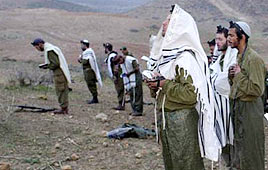 |
| Israeli soldiers praying |
The Bible provides no title for
And, in fact, this is the origin of the title of the 1st century succession of Nᵊtzâr•
The pâ•suqꞋ continues, "and they shall give, a man
כֹּפֶר
נַפְשׁוֹ,
לַ
A more accurate translation of this pâ•suqꞋ is: "that you shall bear the head of the sons of Yi•sᵊr•â•eilꞋ, for the musterings-and-overseeings of them; and, in the mustering-and-overseeing of them, [every] man shall give an expiating-ransom for his psyche." Clearly, the half-shëqꞋël is another aspect of' כֹּפֶר, demonstrating that our "works" (i.e., Tor•âhꞋ-observance) are also required for כִּפּוּר. This corroborates our long-standing position that
This brings up a question raised by one of our ta•lᵊmid•imꞋ: does full Tor•âhꞋ-observance mean that a geir should observe all of the Tor•âhꞋ concerning, for example, the Kohan•imꞋ?
No, this is not what the Nᵊtzâr•imꞋ mean by full Tor•âhꞋ-observance. As this ta•lᵊmidꞋ correctly pointed out, there have always been divisions between the mi•tzᵊw•otꞋ applicable to Kohan•imꞋ, Lewiy•imꞋ, Yi•sᵊr•â•eilꞋ and geir•imꞋ.
The Nᵊtzâr•imꞋ position is that an individual in one of these categories is required to observe everything that Tor•âhꞋ requires of their category if it is possible. Where it is impossible, or we fail despite our best efforts, that is where
|
|
This is שַׁבָּת
|
|

When, ca. B.C.E. 891, Eil•i•yâhꞋu challenged the nᵊviy•imꞋ of BaꞋal, after they had failed to call down fire on their sacrifice, Eil•i•yâhꞋu repaired a neglected Miz•beiꞋakh of
It isn't until the 9th century C.E. that the right combination of chemicals for gunpowder, in the correct proportions, is documented in the Tang Dynasty in China. However, all of gunpowder's reactive ingredients were known, mined and used in Biblical times – and some of their Biblical uses were closely related to fire.
 |
 Greek Fire Greek Fire |
What isn't widely known is that "Greek fire", an English distortion of the original Byzantine πυρ θαλασσιον, is dated, according to Theophanes (ca. 759-818 C.E.), back to ca. 672 C.E.
The Greek historian, Thucydides (ca. B.C.E. 460-395), mentions the use of "tubed flamethrowers" in the siege of Delium in B.C.E. 424.
The Apocryphal book of II Maccabees recorded – in the 2nd century B.C.E. (!) – the recovery (!) of "automatic fire"; what the modern world calls a spontaneously-combustible, exothermic reaction!
 205x544.gif "naphtha (Ronsonol lighter fluid)") |
| Naphtha – in a more recognizable form (since replaced by butane) |
1.19 "When our fathers were to be led into the land of Persia, the godly priests of that time took some of the fire of the Altar and hid it secretly in the hollow of a sort of empty cistern, wherein they made it sure, so that the place was unknown to all men. 20 Well, after many years, when it pleased Ël•oh•imꞋ, Nᵊkhëm•yâhꞋ was sent on a mission by the king of Persia, and he sent in quest of the fire the descendants of the priests who had hid it. When they announced that they had found no fire, but νεφθαι, 21 he commanded them to draw out some and bring it to him; and when the sacrifices had been duly positioned, Nᵊkhëm•yâhꞋ commanded the priests to sprinkle the liquid both on the wood and on the sacrifices. 22 When this was done, after some time had elapsed, and the sun, formerly hidden in clouds, had shone out, there was kindled a great blaze, so that all men marveled."
Gunpowder is composed of sulfur, charcoal and potassium nitrate. Charcoal has been around for millennia. Only the remaining two ingredients need examining:
 |
 Natural "Brimstone" (גָּפְרִית) deposit around Sulphur Spring at Yâm ha- Natural "Brimstone" (גָּפְרִית) deposit around Sulphur Spring at Yâm ha- |
גָּפְרִית (Sulfur) – occurring naturally as lemon yellow deposits, plentiful around Yâm ha-
bᵊ-Reish•
Dᵊvâr•
Yᵊsha•
Yᵊsha•
Yᵊkhëz•
Tᵊhil•
גֹּפֶר, a likely cognate of גָּפְרִית (this probably a fem. diminutive), is a hapax legomenon found in bᵊ-Reish•
גֹּפֶר-wood probably refers either to the smell or color of גָּפְרִית. None of the candidates posed by recognized scholars smells like sulphur. Only one candidate is a lemon yellow: the acacia (shitim) wood. I obtained a specimen of acacia while in the
 |
 Deposits of Salts in Yâm ha- Deposits of Salts in Yâm ha- |
מֶלַח (Salt, including rock-deposit salt?) – (see also Dᵊvâr•
This naturally occurring compound forms thin whitish glassy crusts (science.jrank.org).
Ancients were inclined to regard knowledge as esoteric, for the initiated, not chemists seeking to properly distinguish, classify and name various chemicals. It is quite possible, in fact most likely, that the מֶלַח used for one purpose could be different from the מֶלַח used for a different purpose with no esoteric distinction appearing in the "public" account. This appears to be hinted when King Avi-mëlꞋëkh destroyed
In primitive practice 'good' tinder can be made better by soaking the firing materials in a solution of saltpeter (salt.org.il)
 |
| Saltpeter = potassium nitrate = KNO3 (wisegeek.org) |
Supporting the idea of an esoteric knowledge of different varieties of מֶלַח, was there a special reason – an accelerant – that the Ko•han•
If the addition of מֶלַח to a sacrifice resulted in a great fireball followed by a furious consuming fire, it would certainly make an impression as a Bᵊrit מֶלַח (Di•vᵊr
"... In the arid zones, potash from lakes, good irrigation and most of all warmth, to help quick fermentation, favoured early and easier development of saltpeter..." ( salt.org.il)
 0250x333.jpg "Ein Boqeiq (Photo Vered Navon 2011.10)") |
 1944x2592.jpg "Click to enlarge") עֵין בּוֹקֵק עֵין בּוֹקֵק(Photo Vered Navon 2011.10) |
SALTPETER FACTORIES AT [Yâm ha-
One of the most ancient potash sources, [Yâm ha-
 |
 Mineral Salts Extraction, Yâm ha- Mineral Salts Extraction, Yâm ha- |
שִׂיד (Quicklime), Calcium oxide (CaO), water-reactive; derived from burning limestone, which is plentiful here – also rendered whitewash or plaster. Quicklime is also thought to have been a component of Greek fire. Upon contact with water, quicklime would increase its temperature above 150°C and ignite the fuel (Croddy).
CaO is known in the Bible:
זֶפֶת (pitch, tar), which was plentiful from Yâm ha-
Shᵊm•
Yᵊsha•
חֵמָר (bitumen, asphalt); believed to have been a component of "Greek Fire"; In ancient times, there were many חֵמָר pits around Yâm ha-
bᵊ-Reish•
bᵊ-Reish•
Shᵊm•
While modern man arrogantly—and sometimes mistakenly—assumes superior knowledge, it's unclear that ancient peoples considered such phenomena "supernatural" like superstitious people today. Certainly, the priests knew how to perform such feats naturally. It is also uncertain that the priests tried to fool the people that such achievements were "supernatural" powers, since it was the knowledge to perform them was regarded of divine origin—(claimed to be) knowledge of the ël•oh•imꞋ, which, they claimed, proved that the priests had been "chosen" representatives of the ël•oh•imꞋ. Thus, the power was understood to be in their demonstration of custodianship of the esoteric knowledge, not in any supernatural "magic" like today's religious charlatans.
In other words, the ancient priests claimed to do natural things through advanced technological knowledge received from false ël•oh•imꞋ (in the form of predecessor priests) while today's counterparts claim to mediate pretend supernatural things by their manipulation (via mystical "angelic" pronunciations, incantations, etc.) of the True Ël•oh•imꞋ.
Rather than pretend to control pretend supernatural powers like charlatans today, the ancient practice among all sorts of priests seems to have been to learn technology in order to demonstrate very real phenomena (in contrast with today's reliance on pretend fakery and false claims) that was inexplicable to the masses, then—with integrity—credit what they thought was due to their ël•oh•imꞋ.
Thus, the ancient religious contest was a technology race. Today's religious rivalry and resulting conflicts, by contrast, pits the logical and historical Tor•âhꞋ against the "supernatural" pretenses of supersessive displacement superstitions.
It then remains to explain how the description matches the science. We read (18.38a) "וַתִּפֹּל
אֵשׁ-י--ה." To paraphrase, "Then fire of
The science of "automatic fire" was lost during the Dark Ages and remained unknown for the past 1-2,000 years. However, modern scientists, consulting Pliny (23-79 C.E.) and other ancient historians, have replicated this feat. Accordingly, relying on modern science, we can surmise filling in blanks purposely left in the account.
 Don't try this at home; you will have a major fire!!!
Just prior to Mi•nᵊkhâhꞋ…
18.31 "Eil•i•yâhꞋu took 12 stones, corresponding to the number of tribes of the children of Ya•a•qovꞋ (to whom the word of
י--ה came, saying, “Your name shall be Yi•sᵊr•â•eilꞋ”).
Quicklime – Calcium Oxide (CaO) 32 He built the stones into a Miz•beiꞋakh for the Name of
י--ה , and he made a trench large enough to plant 15 liters of seed around the Miz•beiꞋakh [which he "seeded" with quicklime, laced liberally with pulverized rock sulphur]. 33 He arranged the wood, butchered the bull, and placed it on the wood. 34 Then he said, “Fill four jugs with ‘water' and pour them over the ascendance-offering and over the wood.” He said, “Do it a second time!” and they did it a a second time. He said, “Do it a third time!” and they did it a a third time [this time completely filling the trench with quicklime and pulverized sulphur around the Miz•beiꞋakh and, perhaps, and for the first time, real water instead of νεφθαι]. 35 The water went all around the Miz•beiꞋakh [into the trough of quicklime and pulverized sulphur] and the water even filled up the trench.
Then Eil•i•yâhꞋu prayed for it to spontaneously combust…
38 “וַתִּפֹּל אֵשׁ-י--ה…"
When water contacts quicklime, the chemical reaction produces well in excess of the heat required to ignite the naphtha spontaneously, which, in turn, ignites both the rock sulphur (producing a great deal more heat ensuring the wood is burning well) as well as igniting the naptha-soaked wood across the entire Miz•beiꞋakh.
|
|
|
The Tor•âhꞋ section (5765) exposes hypocrisy in the modern interpretation of Ha•lâkh•âhꞋ relative to the observance of שַׁבָּת. First-century Pᵊrush•imꞋ RibꞋis recognized not only the principle of piquakh nephesh, later codified in Talmud; they echoed the teachings of RibꞋi Yᵊho•shuꞋa. As I pointed out in NHM (note 12.8.1), R. Yo•nâ•
RibꞋi Yᵊho•shuꞋa presents an even more forceful argument in NHM 12.8. The Jew may serve only One •donꞋ—
Clearly, neither the Beit-ha-Mi•qᵊdâshꞋ nor שַׁבָּת was •donꞋ over the Kohan•imꞋ. Rather, the Kohan•imꞋ were •donꞋ over the Beit-ha-Mi•qᵊdâshꞋ and שַׁבָּת. The legitimate leader ordained by
"Yᵊho•shuꞋa's meaning is that a legitimate Judaic leader designated by
RibꞋi Yᵊho•shuꞋa also corroborated the principle of piquakh nephesh, setting forth the Ha•lâkh•âhꞋ that "One should do good on שַׁבָּת (NHM 12.13).
When one considers that the future Beit-ha-Mi•qᵊdâshꞋ comprises the nᵊphâsh•otꞋ of those who keep Tor•âhꞋ, then the principle of piquakh nephesh and Yi•sᵊr•â•eilꞋ becoming a nation of Kohan•imꞋ converges with the construction and operation of the Beit-ha-Mi•qᵊdâshꞋ by Kohan•imꞋ. Doing good on שַׁבָּת then converges with Kohan•imꞋ operating the Beit-ha-Mi•qᵊdâshꞋ.
Contrary to the popular misrepresentations of hate-mongerers, no teaching of RibꞋi Yᵊho•shuꞋa contravened the Ha•lâkh•âhꞋ—concerning שַׁבָּת or anything else. RibꞋi Yᵊho•shuꞋa was an authoritative teacher of Ha•lâkh•âhꞋ and a "poseiq" (in modern parlance, one who makes determinations of Ha•lâkh•âhꞋ).
|
|
| Tor•âhꞋ | Translation | Mid•râshꞋ RibꞋi Yᵊho•shuꞋa: NHM |
NHM |
||||||||||||||
|---|---|---|---|---|---|---|---|---|---|---|---|---|---|---|---|---|---|
| |||||||||||||||||
| |||||||||||||||||
| |||||||||||||||||
| |||||||||||||||||
| |||||||||||||||||
|
|
A man will always be as careful with a mi•tzᵊw•âhꞋ that appears easy in his eyes as a mi•tzᵊw•âhꞋ that is hard in his eyes. As we recite in chapter 2 of dᵊ Âvot: RabꞋi said, Which Way is straight that shall be honest for a man, etc.? So he should be as careful with the easy mi•tzᵊw•âhꞋ as with the hard. Therefore, when one mi•tzᵊw•âhꞋ shall become opportune to a man he mustn't relax from performing the other mi•tzᵊw•âhꞋ. As it is said, There's no [acceptable] transgressing of mi•tzᵊw•otꞋ.
And to the world-age a man should see to himself that it is because of that one mi•tzᵊw•âhꞋ that he may perhaps tip the scale to his merit. As it is memorized (40.1), To the world-age a man should see himself as half credits and half debits.
He who performed one mi•tzᵊw•âhꞋ—he's happy that he tipped the scale to his credit.
He who transgressed one transgression—Oy for him that he has tipped the scale to his debit.
As it is said, "One misstep shall ruin much good" (Qohelet 9.18). For the sake of one misstep that he has misstepped, this ruined much good. RabꞋi Elazar in [the name of] RabꞋi Shim•onꞋ says: Because the world-age followed the herd concerning the topic under discussion, and the individual followed the herd concerning the topic. [Note: Shᵊm•otꞋ 23.2]
One who performs one mi•tzᵊw•âhꞋ is happy that he tipped the scale, for himself and all of the world-age entirely, toward credit.
He who transgressed a transgression—Oy for him that he has tipped the scale, for himself and all of the world-age entirely, toward debit.
As it is said, "One misstep shall ruin much good."
On account of this single misstep that he absolutely misstepped, he has ruined his own many good [works] as well as [the many good works] of the world-age.
The onus is upon us to study from MoshꞋëh (upon him be peace), [who is] the •donꞋ of all of the nᵊviy•imꞋ, whole in all of the mi•tzᵊw•otꞋ. There hasn't been another like him in the world-age—and he favored perpetuating one mi•tzᵊw•âhꞋ [especially], as it is memorized in Pirqa Qama dᵊ-Sotah (13.1): The Rababan taught: Come and see how Mosh•ëhꞋ favored perpetuating the mi•tzᵊw•otꞋ. All of Yi•sᵊr•â•eilꞋ busied themselves with looting, but he busied himself with mi•tzᵊw•otꞋ, as it is said, 'The wise-hearted will take mi•tzᵊw•otꞋ' (Mi•shᵊl•eiꞋ Shᵊlom•ohꞋ 10.8).
From whence did MoshꞋëh know where the tomb of Yo•seiphꞋ was? But they said, Serakh Bat-Asheir was left behind, etc., as it is above in chapter 6, the section on tomb of the dead (section 212b).
We find also that we shouldn't lust to enter hâ-ÂꞋrëtz, except as a means for perpetuating the mi•tzᵊw•âhꞋ concerning hâ-ÂꞋrëtz. As it is memorized at the end of the chapter (Sotah 14a), RabꞋi Simlai interpreted, "For what reason [lit. because of what did] Mosh•ëhꞋ lust to enter hâ-ÂꞋrëtz? Did he have to eat from its fruit or to satiate himself from its good? Rather, Mosh•ëhꞋ said thusly: "Many mi•tzᵊw•otꞋ are commanded of Yi•sᵊr•â•eilꞋ [some of which] cannot be kept except in hâ-ÂꞋrëtz. I will enter hâ-ÂꞋrëtz in order to keep all of them."
Ha-Qâ•doshꞋ, Bâ•rukhꞋ Hu, said to him, "You're asking nothing solely for the purpose of receiving remuneration. I will credit you as if you performed them." As it is said, "Therefore, I will assign him a portion among the many", etc. "and he bore the kheit of many and interceded for the posh•imꞋ." (Yᵊsha•yâhꞋu 53.12).
"Therefore, I will assign him a portion among the many"—Can it not be like the latter [the many who came to Ërëtz Yi•sᵊr•â•eilꞋ to establish the mi•tzᵊw•otꞋ] and not the first [generation of the Yᵊtzi•âhꞋ]? Tal•mudꞋ says, "and to those who are mighty He will apportion booty" * (ibid.) like Av•râ•hâmꞋ, Yi•tzᵊkhâqꞋ and Ya•a•qovꞋ, who were mighty in Tor•âhꞋ and in the mi•tzᵊw•otꞋ.
 Khat-shepset 12 uraei forehead cobras (maat) Hathor horns (ka) solar disk Ra) front 250x375.jpg "Egyptian calf mask: front") |
 Khat-shepset 12 uraei forehead cobras (maat) Hathor horns (ka) solar disk Ra) rt 480x720.jpg "Click to enlarge left view")  Khat-shepset 12 uraei forehead cobras (maat) Hathor horns (ka) solar disk Ra) front 480x720.jpg "Click to enlarge front view") Pattern of the "Golden Calf": Egyptian ( Pattern of the "Golden Calf": Egyptian ( |
"In place of whom [namely, the posh•imꞋ, like the generation of the Yᵊtzi•âhꞋ] he bared his nëphꞋësh to death" (ibid.)—that he delivered himself to death as it is written, "And if not, erase me, I prithee, from Your Book," etc. (Shᵊm•otꞋ 32.32).
"And with the posh•imꞋ he was counted" (Yᵊsha•yâhꞋu 53.12)—that he was counted with the dead of the midbâr [following the Yᵊtzi•âhꞋ: e.g. A•har•onꞋ, Mosh•ëhꞋ and the generation who witnessed Har Sin•aiꞋ but weren't permitted to enter hâ-ÂꞋrëtz).
"And he bore the kheit of many"—that he made ki•purꞋ concerning the Ma•as•ëhꞋ of the [gold] cow [namely, the Egyptian idol-mask of Hathor).
In the incident of the "Golden Calf" (mask), contradicting the primary rabbinic quasi-halakhic claim to rule (that everyone must follow the רֹב – by which they mean the rabbinic consensus),
Yi•sᵊ
Shᵊm•
"And interceded for the posh•imꞋ"—he requested rakham•imꞋ for the posh•imꞋ of Yi•sᵊr•â•eilꞋ who will return tᵊshuv•âhꞋ; and there is no intercession except tᵊphil•âhꞋ as it is written: "And you, don't pray on behalf of this am, don't bear jubilance or tᵊphil•âhꞋ on their behalf and don't intercede [for them] in Me" (Yi•rᵊmᵊyâhꞋu 7.16).
* Note: This is a more accurate rendering of the original Hebrew of Yᵊsha•yâhꞋu 53.12, verified in iQIsa. Interestingly, the meaning revealed here is corroborated by the teaching of RibꞋi Yᵊho•shuꞋa, almost certainly relative to this pâ•râsh•âhꞋ, in NHM 25.14-30.
When [Mosh•ëhꞋ] knew that he couldn't enter hâ-ÂꞋrëtz, he fulfilled the mi•tzᵊw•âhꞋ by his love of the mi•tzᵊw•âhꞋ. As it has been memorized in Ma•sëkꞋët Mak•otꞋ, chapter "These are the exiles" (10a), Rabi Sismai inquired, "What is written? 'Whoever loves money shall not satiate [himself with] money' (Qo•hëlꞋët 5.9). This is MoshꞋëh, who was aware that there wouldn't be three cities [of refuge] across the Yardein [river] to absorb [refugees] until three were chosen in hâ-ÂꞋrëtz. [Recognizing this opportunity to establish a mi•tzᵊw•âhꞋ,] â•marꞋ, "A mi•tzᵊw•âhꞋ that came into my hand I will keep it."
Whoever loves his crowd has [its] produce (ibid. [i.e., one reaps what he sows). For whom is the study of the crowd befitting? For whomever everything [of that crowd] becomes his produce. This is what Rabi Eliphâzâr said: "What is written? 'Who shall verbalize the heroics of
Therefore, let not maintaining the mi•tzᵊw•otꞋ be a slight [thing] in the eyes of any man, great or small. And if it is despised in his eyes [yet, he performs the mi•tzᵊw•âhꞋ despite disliking it], perhaps it is great in the eyes of the Creator to give him משלם (mushᵊlâm; complete) reward [lit. wage]. And concerning a dâ•vârꞋ like this, â•marꞋ שלמה (ShᵊlomꞋoh) ha-mëꞋlëkh (upon him be השלום [ha-Shâ•lomꞋ], "Whoever despises a dâ•vârꞋ shall corrupt himself, but whoever shall ירא (yi•rᵊeiꞋ; revere) a mi•tzᵊw•âhꞋ ישלם (yᵊshulâm; shall be complete[ly rewarded])" (Mi•shᵊl•eiꞋ Shᵊlom•ohꞋ 13.13).
|
|
|


