
 |
 Beit ha- Beit ha- |

Authentic Teachings of
Oral Law in First Century Judaism
The assertion by Prof. Joseph Patrich of the Hebrew University Institute of Archaeology locating the site of the Beit ha-
This passage seemed to mean that the priest standing on the Mount of Olives was facing the main entrance to the Temple sanctuary in the inner court.
This notion was reinforced by [
Ta•lᵊmudꞋ ,Ma•sëkꞋët Mid•otꞋ ] in its description of the Temple compound's walls. 'All the walls were high except the eastern wall, so that the priest who burnt the red heifer might, while standing on the Mount of Olives, by directing his gaze carefully, see the entrance of theHei•khâlꞋ at the time of the sprinkling of the blood.'
Drawing (Temple1) shows Prof. Patrich's description of the location of the Temple compound (the rectangle defined by a solid line in the center of the drawing). (Drawings by Leen Ritmeyer).
Red line demonstrates line of sight from the crest plateau of Har ha-Zeit•imꞋ through שַׁעַר הָרַחֲמִים (blue dot).Kaufman had been mulling over this detail when he read the passage from
Yᵊkhëz•qeilꞋ [8.16] that [ërꞋëv שַׁבָּת]… As soon as שַׁבָּת was over, he took out a map of יְרוּשָׁלַיִם and began tracing out east-west lines of sight from the top of the Mount of Olives to the Temple Mount about 800 meters distant. Kaufman presumed that the ceremony was conducted near the crest in order to permit the priest to look over the eastern Temple compound wall. (Although this wall was lower than the rest, it could not be too low because the Temple was also a walled fortress.)The flat crest of the Mount of Olives for the most part was too northerly to permit an east-west line of sight to the Temple Mount: From the crest's southernmost end, however, Kaufman drew a line that reached the Temple Mount near the [שַׁעַר הָרַחֲמִים – a key clue], about 95 meters from the center of the Dome of the Rock. There could be no east-west line of sight to the Dome of the Rock itself from the ridge crest.
Drawing a line of sight from the crest plateau of Har ha-
Several archeologists have argued that Prof. Kaufmann's site, the present-day "Dome of the Tablets" (≅70 meters north of the gold-domed mosque), either would have located it in a fosse or left no room for the Antonia Fortress. It must be remembered that the Beit ha-
 |
 Line of sight from Har ha-Zeit•imꞋ begins (in photo) at yellow disk and proceeds through שַׁעַר הָרַחֲמִים to the ancient site of the QoꞋdësh ha-Qâ•dâsh•imꞋ containing the A•ronꞋ hâ-Eid•utꞋ—the purple disk—entirely bypassing the mosque. Line of sight from Har ha-Zeit•imꞋ begins (in photo) at yellow disk and proceeds through שַׁעַר הָרַחֲמִים to the ancient site of the QoꞋdësh ha-Qâ•dâsh•imꞋ containing the A•ronꞋ hâ-Eid•utꞋ—the purple disk—entirely bypassing the mosque. |
Further, Josephus described a significant separation, probably a valley or fosse, between the north wall of the Beit ha-
 Beit ha- "First Temple" Foundation Stones
Diag. #1 – Rock mass, hi-lighted in green, formed part of the northwest corner of חֲצֵר הַכֹּהֲנִים – also called הֶחָצֵר הַפְּנִימִית – in the Beit ha- The west face, shown in yellow, was cut at an angle of 6° south of an east-west axis, corresponding to the orientation of other features of Beit ha- The upper level of the rock is the actual surface level of הֶחָצֵר הַפְּנִימִית. When the Beit ha- The working of the rock mass to accommodate the masonry of the northwestern corner of the חֲצֵר הַכֹּהֲנִים can be seen from a different angle (note the rock mass in hi-lighted in green again), circled in red (before, notice door hi-lighted in blue). Arab Muslims bulldozed this evidence and removed it (after, notice door hi-lighted in blue). Remnant of "First Temple" Inner Court West Wall
Diag. #8 – Rock ledge (lower center of photo, two rows of stones at the bottom left of the door) built on the foundation of the Western Wall of הָעֲזָרָההַ גְּדוֹלָה– before) and after destruction and removal by Arab Muslims. This wall was later used to form part of the southwestern gateway complex leading to the הֶחָצֵר הַפְּנִימִית of the Beit ha- Diag. #10 – Cistern I, situated nearby or beneath יָם הַנְּחֹשֶׁת, between the Diag. #13 – Wall, exposed by Muslim trench in 1979, forming the foundation of the γεισιον (geision), the term used by Josephus to designate the parapet surrounding the חֲצֵר הַכֹּהֲנִים in the Beit ha-
Diag. #14 – ("Tank xxix") crypt supporting northeastern angle of the חֲצֵר הַכֹּהֲנִים and part of the הָעֲזָרָההַ גְּדוֹלָה. An extract from the description of this feature discovered by Warren is particularly significant: "The Souterrain [crypt] has no appearance of having been constructed for a tank; there is not a sign of plaster about, … [it] was apparently built for the purpose of raising up the Beit ha- Diag. #15 – Remains of northern rock wall in the basement of the small domed house, marks southern Wall of הָעֲזָרָההַ גְּדוֹלָה (#16, tank xxiv; pp. 52 & Plan of Beit ha- Diag. #18 – Wall remains bounding the הָעֲזָרָההַ גְּדוֹלָה, on the north side" (p. 58) Other Muslim destruction or removal of physical archeological remnants include:
|
 |
| Red line indicates line of sight from Har ha- |
 |
 Khât- Khât- ) ) |
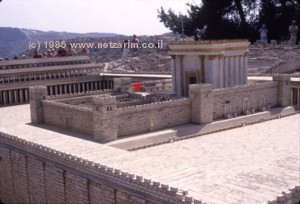
Prototype of Beit ha-
The similarities in architecture between the Temple built by mutTut Moses for his lover, Queen
For example,
Moreover, what, in Tut Moses III) to do his best to erase his own mother from Egyptian history, chiseling away almost every record of her in the Karnak Temple Wall? What black mark in Egyptian history (as perceived by Egyptians, of course), if not the
We demonstrate, in The Mirrored Sphinxes Live-LinkT , that the Tut Moses I (ruled from ca. B.C.E. 1528-1518). His 12-year-old daughter grew up to become Queen Tut Moses II, who died young (and a bit mysteriously). She then became the lover of an otherwise unidentified member of the Pharoanic household (mutTut Moses III (the
Being adopted into the household of Tut Moses, the Hebrew infant, who grew up as an Egyptian Prince, would have been known by his adopted Pharaonic family's name: Tut Moses!!! However, the Hebrews were forbidden to pronounce the name of a foreign god (viz., Tut). Consequently, they would have dropped Tut from Tut-Moses; calling him simply "מֹשֶׁה"; thereby excluding the idolatrous Egyptian first name.
To forestall popular, but frivolous, objections, it isn't clear whether the Hebrews adopted the Hebrew name מֹשֶׁה because it sounded similar to the Egyptian pronunciation (anglicized to "Moses") and whether the verb root מָשָׁה – of uncertain origin (according to Klein's), developed from the Hebrew pronunciation of the Egyptian surname anglicized to "Moses"; rather than the reverse.
The references in ).
It seems inescapable that Moses' plans for the Beit ha-
 |
| Beit ha- |
The Beit ha-
The Dead Sea Scrolls, particularly (4Q) MMT, the Pseudepigrapha, and other early Judaic documents all corroborate pre-5th century source documents concerning the "Oral Law" controversy in the 1st-century Jewish community.
 |
| For details, see Asher S. Kaufman, Where the Ancient Temple of Jerusalem Stood," Biblical Archeology Review, 1983.03, p. 40ff and related articles by Dr. Kaufman. |
Prof.
Oral Law was accepted by all of the sects of legitimate Judaism recognized by the unquestioned authority of legitimate Judaism on earth — the Beit Din hâ-
The dispute, instead, revolved around whether Oral Law should be codified (written) or remain transmitted exclusively orally.
The
Who Are The Nᵊtzarim? Live-LinkT (WAN) shows, based on Dead Sea Scroll 4Q MMT, that no element of legitimate 1st century Judaism could possibly have compromised even the minutest point of
The
Furthermore, as Eusebius most pointedly recorded, the
5.17-20"I didn't come to subtract from the Torâh of MoshꞋ or the Neviim, nor to add onto the תּוֹרָה of MoshꞋ did I come. Because, rather, I came to [bring about the] complete [i.e., non-selective] observance of them in truth.
Should the heavens and hâ-
ÂrꞋ ëtz exchange places, still, not even one י or oneof the
Ha•lâkh•âhꞋ of the תּוֹרָה of Mosheh shall so much as exchange places; toward the time when it becomes that they are all being performed -- i.e., non- selectively -- in full.For whoever deletes one [point of] the Ha•lâkh•âhꞋ of these
mi•tzᵊw•otꞋ from תּוֹרָה, or shall teach others such, [by those in] the Realm of the heavens he shall be called 'deleted.' And whoever ratifies and teaches them shall be called ' Ribi' in the Realm of the heavens.For I tell you that unless your tzᵊdâqâh is over and above that of the [Hellenist-Roman Hellenist
Tzᵊdoq•imꞋ ] Codifiers ofHa•lâkh•âhꞋ , and of the Rabbinic- Perushim sect of Judaism, no way will you enter into the Realm of the heavens." (see NHM
 |
| Karen & Yael at Qumran Cave. Photograph © 1994 Yirmeyahu Ben-David. |
The Nᵊtzârim introductory book, WAN Live-LinkT Technology demonstrates from the source mss. of the NT, from the early Jewish and Church historians, the Pseudepigrapha, the Dead Sea Scrolls (especially 4Q MMT), et al. that it's absolutely impossible that either Ribi Yᵊhoshua or his original followers, the Nᵊtzarim, ever advocated the 2nd to 4th century antinomian (gentile Roman) Christian doctrine of selective observance.
Logically, selective (i.e. partial) observance equates to partial rejection of Torâh.
In short, we demonstrate that no legitimate transition from Ribi Yehoshua and his original Nᵊtzârim followers to Christianity is even possible! Ribi Yehoshua Ben-Yoseiph Ben-Dawid of Natzrat (corrupted to "Nazareth") not only supported the Perushim Ribis in opposing the Hellenist Tzedoqim effort to end the oral transmission of
See NHM 23:1-3; documentation and details in the books WAN Live-LinkT Technology and Atonement In the Biblical 'New Covenant' Live-LinkT (ABNC)
The
Though controversy raged over whose interpretation of Oral Law was authoritative and how it should be transmitted, no sect in the 1st-century Jewish community ever considered rejecting the body of Oral Law. Further information and documentation are found in WAN Live-LinkT Technology and ABNC Live-LinkT Technology.

 |
|
 |


