
 |
| Pâ•qid&#xxxa78b; Yi•rᵊmᵊyâhꞋu |
2015.03.27 — Reviewers typically point out a couple of good things and a couple of bad things, then summarize. O'Reilly's movie is a solid baby-step in the right direction. But if I devoted proper space to writing the good, I couldn't adequately point out those things that still require correction.
Movie-goers mindlessly expecting to see the Christian Jesus depicted instead of the historical, real, 1st-century Jew and Pᵊrush•iꞋ RibꞋi Yᵊho•shuꞋa will be deservedly bewildered and vexed. The two have always been mutually exclusive: Christian Jesus, which was syncretized and superimposed, by Hellenist Roman gentiles, onto their native idol, Ζεύς, over the period of the three centuries subsequent to 135 C.E. was always the polar opposite and contradiction of the historical 1st-century Jew and Pᵊrush•iꞋ RibꞋi Yᵊho•shuꞋa.
I have a rather unique insight into this issue, as it's been the primary motivation and direction of my life and studies. The modern world had never heard of a Nᵊtzâr•imꞋ until I published my book, The Nᵊtzâr•imꞋ Reconstruction of Hebrew Ma•ti•tᵊyâhꞋu (NHM), restoring the term, in 1972. Being raised a Christian and later becoming an Orthodox Jew as a result of realizing that Christianity never displaced Tor•âhꞋ has given me a distinct insight into this kind of movie or book (see the Nᵊtzâr•imꞋ website and my books, below). Academic study doesn't measure up to personal experience coupled with the knowledge obtained through personal life practice — on either side of the fence. I'm an Orthodox Israeli Jew who was raised a Christian, attended Hampden DuBose Academy, was a church organist and became a Baptist preacher before noticing the overwhelming self-contradictions in Christian tradition and Christianity's many intractable contradictions of the historical Judaic record and impossibly contradictory claim of superseding the Jewish Ta•na"khꞋ ("Old Testament") upon which Christianity claims to be based.
Mixing Christian (Hellenist) and Judaic terms as if they're interchangeable is misleading, both to Jews and Christians, respectively (even in this century; don't even think 1st century C.E.). One is always thinking oranges while the other is always thinking pineapples — two often mutually exclusive definitions and perspectives. The intermingling unavoidably masks the pivotal schism between Pᵊrush•imꞋ Tor•âhꞋ versus the Hellenism of the Tzᵊdoq•imꞋ ko•han•imꞋ; the core internal fissure of the 1st century Judaic community that, despite the single-generation scapegoat of RibꞋi Yᵊho•shuꞋa in 30 C.E., recurred to destroy the Beit ha-Mi•qᵊdâshꞋ in 70 C.E. and recurred again to bring exile in 135 C.E. Hence, the exclusive use of Judaic terms, and lack of gentile Roman-Hellenist terms, in this review. It may be difficult reading, even for academics, but glossary links are included and once you've mastered it, you'll finally understand a number of the main issues.
Like earlier books and movies, this one also misses entirely what is reflected in one of my most eye-opening experiences upon embarking on my life-practice of Orthodox Tor•âhꞋ practice: finding and affiliating with the most pristine Tor•âhꞋ tradition remaining on earth: the Tei•mân•imꞋ here in Israel. After having studied the liturgy (how Jews really pray, again unlike these movies) that dates back to antiquity and attended both
While Bill O'Reilly's new movie, "Killing Jesus", is a significant step in this direction, and away from the gentile Roman-Hellenist (Christian) idol-myth, toward the historical 1st-century Jew and Pᵊrush•iꞋ RibꞋi, it still remains over-the-horizon from the historical Tor•âhꞋ-centric Jewish community, described in (4Q) MMT in which it's clear that every Jew, from the most lowly laborers and even their children, chanted Tor•âhꞋ and argued its proper interpretations (Oral Law, Ha•lâkh•âhꞋ) on every issue we find today in Ta•lᵊmudꞋ. No gentile, lacking such Tor•âhꞋ knowledge base, has ever brooked this gap in knowledge — nor is Irish Catholic Bill O'Reilly the first, though I give him credit for advancing the bar significantly.
The publicity trailer gave the impression that, while this movie offering may be an improvement over Gibson's eye-roller, it hasn't filtered out enough miso-Judaic (Hellenist Greek / Christian) distortions to qualify as historical or a documentary.
Even the short publicity trailer betrays the 2,000 year tradition of Christian — Roman Hellenist Greek non-Jews — ignorance, and resulting distortions, of 1st century Judaic history of a Judaic RibꞋi Jew teaching a Judaic Tor•âhꞋ in a Judaic community of Tor•âhꞋ-centric Jews, not Hellenist Greek gentiles, that Dead Sea Scroll (4Q) MMT proved orbited Tor•âhꞋ as the center of their universe.
Take the scene from the movie trailer, in which Mr. O'Reilly has Jesus addressing a crowd of men who intend to stone (lynch) a convicted adulteress.
Well, there's the first kâ•vodꞋ and the first glitch. O'Reilly's movie is the first I recall to acknowledge that Tor•âhꞋ required trial by a Beit Din before any punishment could be rendered, and then only by duly authorized servants of the court. Tor•âhꞋ has never authorized a rabble to lynch anyone based on a simple report. (That includes the oft-cited PiꞋnᵊkhâs.) A long history of Christian representations that Tor•âhꞋ Jews lynched women based on a mere report that she was an adulteress is a miso-Judaic libel.
That brings us to the glitch. Ha•lâkh•âhꞋ required that only an eye-witness to the crime could cast the first stone. Thus, RibꞋi Yᵊho•shuꞋa wasn't addressing even the crowd of Jewish men. Rather, he was asking the eye-witnesses who had testified to her adultery in the Beit Din trial, specifically: which of you (eye-witnesses) is innocent of adultery?
How can we know that she was falsely convicted? She continued to profess tᵊshuv•âhꞋ, which obviates a death sentence (and the legal basis for corroborating her profession to "go and transgress Tor•âhꞋ no more"), which is the verdict that, in the case of tᵊshuv•âhꞋ, Tor•âhꞋ required a Pᵊrush•iꞋ RibꞋi to (form a Beit Din and) pronounce. "A Συνεδριον that passed a death sentence was considered to be a 'a bloody Συνεδριον.'" This refers to the statement in the MiꞋshᵊnâh (Ma•sëkꞋët Mak•otꞋ 1:10; Mak•otꞋ 7a) that a Συνεδριον that kills (gives the death penalty) once in seven years (R. Eleazer b. Azariah said: once in 70 years) is called "bloody" (k?ovlanit, the term "k?ovel" generally implying a type of injury in which there is blood)." (Jewish Virtual Library)
These were tiny villages. Everyone knew everyone and what went on there. It's an old story. How were there eye-witnesses to her adultery unless they were accomplices? Did a wayward youth from a "good family" rape a girl, secretly observed by a couple of buddies? When she reported the rape, did they then counter that she consented? In any case, as suspected eye-witness accomplices, should they no less — first — stone themselves?
Thus, this isn't a Christian "gospel" that Christians typically assume, teaching that everyone should be tolerant of an adulteress or oppose capital punishment, as Christians interpret the incident. (Similarly, the Ten Commandments declare "You shall not murder"; "kill" is a mistranslation.) Rather, this is a teaching against hypocritical abuse of Tor•âhꞋ that rises to blasphemy of י‑‑ה — and which still goes on in religious Jewish communities today! (Not only Jewish communities, of course.)
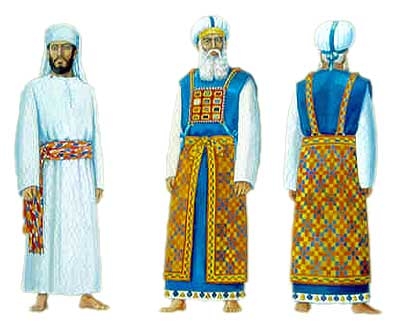 |
| Tzᵊdoq•imꞋ ko•han•imꞋ (left). Ko•heinꞋ ha-Jâ•dolꞋ on right (front and back; illustration by the Temple Institute). |
On the one hand, the movie noted (though missing the Hellenist and sectarian connections) the Hellenist Tzᵊdoq•imꞋ ko•han•imꞋ (who did not wear a ta•litꞋ collaborating with their patron ally Hellenist Roman gentile occupiers. This pitted the Hellenist pair against the fiercely anti-Hellenist (and, therefore, fiercely anti-Tzᵊdoq•imꞋ) Pᵊrush•imꞋ, who wore a ta•litꞋ (at least for prayers) — and included RibꞋi Yᵊho•shuꞋa along with nearly all of the "ordinary Jews" in the villages and crowds. Wildly misleading the audience (and baffling this reviewer), the movie ignored the Biblical-prescribed garb of ko•han•imꞋ (see illustration) to cross-dress the "Hellenist Sadducee priests" of "the Temple" in "Pharisee" ta•litꞋ and garb!
In contrast to O'Reilly's movie, not even Pᵊrush•imꞋ wore kip•otꞋ until the 16th-17th century C.E. Certainly, there is no excuse for having some Jews wear kip•otꞋ but not the RibꞋi or Yᵊho•shuꞋa.
Meanwhile, the movie dressed and passed off the genuine, fiercely anti-Hellenist Pᵊrush•imꞋ, including RibꞋi Yᵊho•shuꞋa, as "undefined irreligious Jews" no different — except, according to the movie's tacit assumption (flying in the face of Dead Sea Scroll (4Q) MMT), by a racist standard — from the Hellenist Roman gentiles they so despised. This blurred roles that were, in 1st century fact, opposites literally poles apart.
1st century Jews did not dress in black, like the movie depicted the Jewish (Hellenist Sadducee) priests. This seemed to encourage a simplistic, false and misleading divide between "religious Jews the bad guys in black garb" vs all others, including the Roman gentiles; whereas the true conflict was between a confederation of Hellenist "Sadducee priests" colluding with their Hellenist gentile Roman patron ruler-occupiers against the fiercely anti-Hellenist Pᵊrush•imꞋ — including RibꞋi Yᵊho•shuꞋa!
O'Reilly's movie notes some misdefined and sectarianly-scrubbed (dressed more like Pᵊrush•imꞋ) Jewish-priest collaboration with the Roman occupation, but completely failed to notice its relationship to Hellenism or its connection to, and bearing upon, the Judean-wide internal sectarian schism that divided the Hellenist Jewish priestly elite minority from the overwhelming majority of fiercely anti-Hellenist Pᵊrush•imꞋ who included RibꞋi Yᵊho•shuꞋa.
To its credit, the movie avoided the simplistic and fictional, Jewish-gentile racist canard. (Since, until 200 C.E., when Roman Emperor Severus prohibited conversions to Judaism upon pain of death, gentiles could become Jews, the distinction was religious, not racial, making racist claims impossible until conversions were prohibited.) On the other hand, the movie was utterly oblivious to the core internal Jewish issue: Hellenist inroads and assimilation that had irreparably split the 1st century Tor•âhꞋ-centric Jewish community described in (4Q) MMT along "Sadducee-Pharisee" lines. This was sorely evident in the movie as it compounded the confusion by cross-dressing the two sects of "Jews", sanitizing the movie of the all-overriding internal Judean-wide sectarian schism. These bedrock core issues of the conflict were entirely missed, blurred or confused and lost in the movie.
Gershom Sholem and other Jewish Music historians concur that the most pristine tradition of ancient Judaic music is the tradition of the Tei•mân•imꞋ Jews. It is their liturgy, alone, that has the only authenticity and legitimacy in any movie claiming to be historical or a documentary of RibꞋi Yᵊho•shuꞋa.
Displacing the best-preserved 1st century Judaic chants with liturgy of Displacement Theologies is deplorably misleading and miso-Judaic.
O'Reilly's movie is correct in interpreting the promt of the visit by the Persian priestly astrologer(s) according to Persian Zoroastrian astronomical-astrological interpretations of the stars, constellations and conjunctions. In fact, computer simulations, thanks to the assistance of Dr. E. Myles Standish Jr. of the Jet Propulsion Laboratory in Pasadena, Ca., enabled me, back in 1972, to pinpoint and publish RibꞋi Yᵊho•shuꞋa's precise date of birth, which subsequently have been corroborated by a number of cross-referencing historical events also documented in my book, The Nᵊtzâr•imꞋ Reconstruction of Hebrew Ma•ti•tᵊyâhꞋu (NHM).
On the other hand, it's farfetched to imagine that the Pharsi-speaking Persians had ever heard of the Greek "Isaia." The magi inquired of Herod, rather, concerning their astronomical-astrological signs and their own, Persian Zoroastrian, interpretations. King Herod, being an Εd•om•iꞋ (Idumaean, whose great-grandparents were forcibly converted by a Tzᵊdoq•iꞋ, whereas forced conversions were not recognized by the Pᵊrush•imꞋ, which included RibꞋi Yᵊho•shuꞋa), it's unlikely that even he knew who "Isaia" was. Only after the royal court Hellenist Tzᵊdoq•iꞋ Jewish ko•han•imꞋ apprised them how their signs might parallel Judaic interpretations did they first learn about Ήσαῒας (Tzᵊdoq•iꞋ Hellenization of יְשַעְיָהוּ).
Subsequent corroborations included shepherds in the field, which ruled out winter. Herod died in B.C.E. 4, ruling out 0 C.E. of Christian tradition (which began centuries after the fact and was based on the Dec. 25 sun-god celebration). Josephus recorded the census as beginning in B.C.E. 8, which required the Bën-Dâ•widꞋ family to move from Nâ•tzᵊr•atꞋ to Beit LëkhꞋëm in the year preceding RibꞋi Yᵊho•shuꞋa's birth.
Something no one imagined until I published NHM, later in his life, RibꞋi Yᵊho•shuꞋa read and expounded his traditional Ha•phᵊtâr•âhꞋ, which annually commemorates one's Bar-Mi•tzᵊwâhꞋ Ha•phᵊtâr•âhꞋ, first read and expounded at age 13 ( Hellenists redacted to "about 12" in their 4th century Greek Διαθηκη Καινη (NT), based on their solar calendar, which differed slightly from the Judaic lunar calendar; KeiphꞋâ, penned by Lukas, 2.41-52). This Ha•phᵊtâr•âhꞋ pinpoints for us the Sha•bâtꞋ subsequent to his birth! Corroborating the date indicated by the computer simulation of the stars in B.C.E. 7, this Bar-Mi•tzᵊwâhꞋ Ha•phᵊtâr•âhꞋ (Yᵊsha•yâhꞋu 60:17–61:9) of RibꞋi Yᵊho•shuꞋa (Ky.-Lu. 2:42ff) pinpoints the week in which RibꞋi Yᵊho•shuꞋa was born! This Ha•phᵊtâr•âhꞋ, no longer in the modern cycle, is found only in the second year of the ancient Triennial Cycle — on the first Sha•bâtꞋ of Thirdmonth of the Judaic calendar; Babylonian name: Sivan — May/June on today's solar calendar. ("Triennial Cycle," Ency. Jud., 15:1387-8).
The movie's depiction of the magi holding a necklace like a divining rod to identify the family is a preposterous imagineering necessitated by a complete lack of any clue how they knew. The critical astronomical reality, confirmed by JPL computer astronomical calculations, is that there were, in the year B.C.E. 7, three conjunctions of the planets which the magi understood to portend a Jewish king of historical proportions. The first conjunction caught their attention and alerted them to research and prepare to inquire for details in the Israeli capital, Yᵊru•shâ•laꞋyim. Upon the magi arrival in Yᵊru•shâ•laꞋyim, the second conjunction was confirmation to them of the information of the Tzᵊdoq•imꞋ ko•han•imꞋ, at the direction of Herod, was true; and, as a result, they traveled to Beit LëkhꞋëm and began holding a on-night vigil over the house of each family who had an infant son under 2 years old. On the night the third constellation appeared, that indicated to them that the infant boy in that house was "the one."
The astronomical dates of conjunctions between "stars" that the magi interpreted as Judaic — the Sha•bâtꞋ planet, שַׁבְּתַאי, and צֶדֶק. "In the years 3754-5 (B.C.E. 7), [S-a-t-u-r-n] and [Z-e-u-s / J-u-p-i-t-e-r] were in conjunction three times in the pre-dawn sky.… according to least apparent angular separation [as seen by the magis' naked eyes], in B.C.E.
Archeologists have excavated hundreds of 1st century-era Judaic mi•qᵊwâ•otꞋ, the usage of which Ta•lᵊmudꞋ explicitly and clearly describes. Christian depictions of "baptism", especially in mixed company, are particularly silly since not even clothes or jewelry were permitted to touch the body during tᵊvil•âhꞋ — much less another person, which would defile and invalidate a complete immersion strictly regulated by Oral Law. While the immersion was witnessed by a supervising observer, touching the person being immersed would invalidate the tᵊvil•âhꞋ. It was neither Christian nor a "baptism."
The Christian doctrines of "Love your enemy" and "Judge not", contradicting and presuming to supersede Tor•âhꞋ, are yet more of the countless examples of Hellenist syncretism through mistranslation. Justice is never to be perverted; repentance and restitution may invoke mercy, but mercy and love can never nullify justice. The English "enemy" derives rather faithfully from the Hellenist (Greek) in the 2 earliest extant Διαθηκη Καινη (NT)- LXX source books (Codices א and β) where the term is μισησεις (as in miso-Judaism), as it is consistently Hellenized (syncretized) in place of the Hebrew sâ•neiꞋ (eschew; e.g., Tor•âhꞋ never instructs children to "hate" their parents), instantiated both in Ta•na"khꞋ and the OnꞋᵊqᵊlos Tar•gumꞋ).
Corroborating the connotation of eschew relative to family members, RibꞋi Yᵊho•shuꞋa exclusively addressed his fellow Jews, often in a beit kᵊnësꞋët. There wasn't an "enemy" in the crowd; nor was any "enemy" referenced. This was about interacting with fellow Jews. The occasional gentile in the audience was, by definition, in every case a geir; never a gentile. (Even the "spies" seeking to kill him were Tzᵊdoq•imꞋ Jews, not gentiles.) Thus, like "eschewing", not "hating", a father or mother, his remarks were about loving even your fellow Jew who "eschews" you; not loving your "enemy."
This discussion has no basis in the only account endorsed by the 1st century Jewish followers, the Nᵊtzâr•imꞋ Jews (namely, The Nᵊtzâr•imꞋ Reconstruction of Hebrew Ma•ti•tᵊyâhꞋu (NHM)). It is admissible only as a valid inference from other Judaic knowledge of the period. The phrase "born again" originated as an inherently Judaic description within the ancient Jewish community of a gentile converting, being born anew (again) into a different religion, into Tor•âhꞋ practice as a son or daughter of Yi•sᵊr•â•eilꞋ. It would make perfect sense to advise an arkhon of the Sanhedrin (Nikodæmos) that tᵊshuv•âhꞋ parallels a gentile conversion; both involve a "rebirthing anew (or renew)" into new (or renewed) Tor•âhꞋ practice. It would also be understandable how an arkhon of the Sanhedrin would fail to grasp his need to make tᵊshuv•âhꞋ — and since he was born into Yi•sᵊr•â•eilꞋ the first time, this left him without an answer to which he could easily relate and understand why he would need to be born into Yi•sᵊr•â•eilꞋ when he was already born into Yi•sᵊr•â•eilꞋ the first time and, as an arkhon of the Sanhedrin, likely didn't see any need for making tᵊshuv•âhꞋ.
This incident is another example of the Christians' and other gentiles' lack of Tor•âhꞋ knowledgebase, ignorance that misdirects them into contra-Judaic misconceptions that are alien and contradictory to Tor•âhꞋ. Everyone, gentiles as well as Jews, is born a first time physically. But only Yi•sᵊr•â•eil•imꞋ are born into Yi•sᵊr•â•eilꞋ the first time, requiring being "born again" (making tᵊshuv•âhꞋ). Gentiles cannot make tᵊshuv•âhꞋ — a return to a life they've never lived. So "born again" has a different connotation within Yi•sᵊr•â•eilꞋ (tᵊshuv•âhꞋ) than it does to gentiles (born anew into a different religion).
Tᵊshuv•âhꞋ is the original, and only authentic — Judaic — "plan of salvation": he who repents, makes restitution and returns to Tor•âhꞋ-practice is "saved" from the otherwise unavoidable sentence. Contrary to miso-Judaic Christian misconceptions, RibꞋi Yᵊho•shuꞋa, having sᵊmikh•âhꞋ as head of a Pᵊrush•iꞋ Beit Din, was obligated to overturn the local (lower), apparently ad hoc, lower court. Contrary to miso-Judaic Christian misleadings, the principle of tᵊshuv•âhꞋ that RibꞋi Yᵊho•shuꞋa cired, has always been, and remains, the guiding Tor•âhꞋ principle — the principle the lower local court had been obligated, but remiss, to hold.
RibꞋi Yᵊho•shuꞋa spoke Hebrew and Aramaic of the Pᵊrush•imꞋ, not the Greek of the Hellenists. He called Shim•onꞋ כֵּיפָא, not Πέτρος; and he was teaching Tor•âhꞋ, to Jews (not Hellenists or gentiles) about a spiritual beit kᵊnësꞋët (Hellenized to "synagogue") of Tor•âhꞋ Jews, not a new concept of a Roman gentile Hellenist Christian ἐπίσκοπος ("church") that wasn't conceived until more than a century after his death (after 135 C.E.).
Although "Nazarene" is a laudable step up from the erroneous translation "of Nazareth" (to bury the dependency implied in Yᵊsha•yâhꞋu 1.11; an early rejection and "stepping away" by the gentile Christian church from being an offshoot dependent upon the Judaic and Tor•âhꞋ Root נְצָרִים), the Hebrew and Aramaic Pᵊrush•imꞋ Jewish community did not refer to him in Greek or by an (abhorrent) Hellenist demonym: "Ναζαρηνός". Yet, until I began publishing the restoration of the term in 1972 (NHM), no one since 333 C.E. had even heard of the Hebrew term: נְצָרִים".
All of Christian clergy has always kept hidden from Christians that the earliest Church historian, Eusebius, documented that the original followers of RibꞋi Yᵊho•shuꞋa, the Nᵊtzâr•imꞋ, accepted only Hebrew Ma•titᵊyâhꞋu (NHM); deeming all the rest of the Διαθηκη Καινη (NT) invalid. But in this modern era, you can simply Google it and learn what the Church has hidden from you. This quote from "John", a forgery written centuries after the fact, contradicts the Tor•âhꞋ that RibꞋi Yᵊho•shuꞋa taught as Authority. Nothing outside of NHM has any place in a historical work or documentary claiming to be an account of RibꞋi Yᵊho•shuꞋa or the Nᵊtzâr•imꞋ.
Palm fronds associated with the "Triumphal Entry" inform the Tor•âhꞋ-knowledgeable reader that this occurred at a previous Suk•otꞋ entry into Yᵊru•shâ•laꞋyim; and not part of the final PësꞋakh entry, which even the dull should realize would have been at least innocuous, likely surreptitious, given the rational approach of RibꞋi Yᵊho•shuꞋa and the obvious dangers of being captured and killed before the PësꞋakh SeiꞋdër.
I was astonished that the makers of the movie apparently ignored every newsreel video of Arab leaders getting off a plane, either arriving in another Arab country or returning home, greeting each other with a kiss near each ear. Although it would be odd today, in that era there was nothing unusual about the customary and respectful greeting of his RibꞋi by יְהוּדָה אִישׁ קְרִיּוֹת ("City-boy" YᵊhudꞋâh; see NHM Note 10.4.2).
References in Ta•na"khꞋ cited as the bases for the phrase "son of God" always refer exclusively to Yi•sᵊr•â•eilꞋ or her anointed king as her representative (see Son of God).
The RibꞋi recited the beginning (second verse, first verse is an introduction) of Tᵊhil•imꞋ 22. If one reads the rest of that chapter, especially verses 16-18, his intent will become clear.
ΟΥΤΟΣ ΕΣΤΙΝ ΙΗΣΟΥΣ |
Employing a reform rabbi, who, despite his Ph.D. in the subject, grasps neither Judaism nor Christianity beyond that of an outside observer, as a token Jewish rabbi (Joshua D. Garroway, Ph.D. Hebrew Union College) was an insult to the intelligence of any knowledgeable Jew (and many Christians) in the audience.
Mr. O'Reilly's movie (and, presumably, his book upon which the movie is based) still continues the 2,000 year tradition of myriad confused gentile Hellenist Roman misconceptions and false "authority" about Judaic concepts — gentiles who can't even read Tor•âhꞋ (it's Hebrew and Aramaic) pontificating about a 1st century Tor•âhꞋ teacher in a 1st century Tor•âhꞋ community discussing and practicing Tor•âhꞋ principles; and those pontifications based on a Hellenized Greek distortion (the Διαθηκη Καινη (NT)) composed over a period of 3 centuries AFTER displacing Jews from Yᵊru•shâ•laꞋyim in 135 C.E.
Casting an anti-Tor•âhꞋ Arab to play a 1st century Tor•âhꞋ Jew and RibꞋi is a miso-Judaic misrepresentation — compounded by feeding the "Palestinian" propaganda machine that holds that Jesus was a "Palestinian". On top of all that, the actor is a Muslim who, by definition, holds that Tor•âhꞋ has been corrupted by Jews. Together, they've produced an apostasy written by a 1st Order Displacement Theologist (Christian) that stars a 2nd Order Displacement Theologist (Muslim), each of whom claims that the Tor•âhꞋ taught by the 1st century Jew and Ribi who is the central character of the movie, has been superseded and invalidated by their respective religion.
Casting an Arab to play a 1st-century Jew, while a baby-step forward from past Hollywood castings of Europeans, is much more than the stinging, anti-Israel face-slap against every Jew, and especially Israeli Jews whose ties to our land, versus "Palestinian" Arabs, are based on our indigenousness here. Historically, the 1st century Judaic community was virtually devoid of Arab populous. The most prominent Arab family, all of whom should have been played by Arabs to be authentic, was the Herods, who were Εd•om•imꞋ. Authenticity in casting would require that only a Tei•mân•iꞋ Jew, the least genetically or religiously intermingled Jews on the planet, dressed and groomed as when they first made a•liy•âhꞋ to Israel, look most like 1st century Jews. Not even any other Jews would fit the bill of playing any member of the Jewish crowds or RibꞋi Yᵊho•shuꞋa.
The idea of gentiles, who have no knowledgebase in, nor comprehension of (nor, indeed, can even read), the Tor•âhꞋ that RibꞋi Yᵊho•shuꞋa taught pontificating about "Jesus" is ignorant. Judaically historical corrections are accessible (see About the author, below).
Pâ•qidꞋ Yi•rᵊmᵊyâhꞋu's books (all available in English, from www.schuellerhouse.com) have irreversibly changed the course of religious debate among the three Abrahamic faiths: Who Are the Netzarim? (English or Hebrew), Atonement Under the Biblical "New Covenant", the only Judaically-correct historical record: The Netzarim Reconstruction of Hebrew Matityahu (NHM), The 1993 Covenant (published in 1990, before Oslo, predicting 7-year pact of Daniel), The Mirrored Sphinxes (science-oriented docunovel of Moses and the Exodus) and Pishtah Keihah (the Flickering-Out Wick), based on Yᵊsha•yâhꞋu 42.1-4).
Innumerable Judaic restorations, correcting millennia of apostasies perpetuated by non-Jews ignorant of the Tor•âhꞋ taught by the 1st century RibꞋi, are documented in the Nᵊtzâr•imꞋ website (in the site's navigation panel at left, click the History & Archeology Museum icon). Access archived articles (Web Café, then Archives icons) and study the science-oriented weekly pâ•râsh•atꞋ Tor•âhꞋ (beit kᵊnësꞋët, then SeiphꞋër Tor•âhꞋ icons). His blog articles are accessible at Times of Israel blogs.


 |
|
 |